




With a third-party payment platform, someone in a city finance office logs in every morning and runs a manual payment import. It pulls in whatever residents paid online over the last 24 hours and posts it into the system, and most days that's the end of it. Then the person who normally runs it takes a week off, or it slips through the cracks on a busy Monday, or a resident pays right on their due date and that payment doesn't show up until the next morning's run. Now that resident is getting shut off for a bill they already paid.
Nobody sets out to build a process that works this way. It happens because the system residents pay through isn't talking to the system a city runs on, so somebody has to bridge that gap by hand, and hand-built bridges break.
I've walked a lot of cities through what changes once that gap closes. It comes down to five things, and every one of them shows up as real time or real money back.
1. It eliminates manual payment processing labor, and the errors that come with it
Most third-party online payment setups run on a batch job, usually first thing in the morning. This pulls in the previous day's payment data and posts it. It's not a huge time commitment on its own, but it's manual, which means it depends on a person remembering to run it. If they're out, or it gets forgotten, that data just doesn't show up.
Where this bites hardest is around cutoff and shutoff time. Say the due date is the 1st and someone pays on the last day of the month. If that batch job hasn't run yet, their payment isn't reflected, and they end up getting shut off despite having paid on time. That's not a rare edge case either. Cities that switch to real-time posting see a clear drop in shutoffs that never should have happened in the first place.
There's a quieter problem too. Import a batch of payments and sometimes one of them didn't fully go through, the bank never pulled the money even though it looked successful on the front end. Now there are three different numbers to untangle:
- What the import shows
- What cash receipting shows
- What the bank shows
Someone has to sort out why they don't match, and track down the discrepancies.
With a real-time, native integration, none of that batch-and-hope process happens. Payments post the moment they're made, so there's no lag and reconciliations are a breeze.
2. It frees up funds sitting in someone else's holding account
This one is bigger than most finance directors realize. If your city's current processor requires a holding account, the payments made don't land in the city's account directly, they go into that holding account first. The city reconciles what came in, then transfers it over, and that transfer usually comes with strings attached. There's often a required minimum balance, sometimes around $25,000, or a penalty kicks in, and a cap on how many transfers you can make per month before another penalty hits.
The penalties aren't the real cost. The real cost is the interest-based revenue the city never collects.
That $25,000, plus whatever's waiting to be transferred, isn't sitting in the city's own account earning anything.
Take a mid-sized city processing something like $250,000 a month in payments. Even at a modest rate, a tenth of a percent, that's real money the city leaves on the table every single month, simply because the cash isn't parked where it belongs.
This is the point that widens finance directors' eyes the most, because it isn't a fee comparison. It's uncollected revenue. I've seen cities switch even when the transaction fees on the citizen portal came in a little higher than what they were paying before, because the interest they picked up more than made up the difference.
Want a quick reference to bring to your next budget conversation? Grab the one-pager below.
3. It cuts reconciliation time down close to nothing
Reconciliation is always the same basic task. You confirm the amount that came in matches the amount that got deposited. But if a holding account is part of your setup, that work doubles, since you reconcile what landed in the holding account, then reconcile it again once it moves into the city's real account.
With a connected portal, payments deposit as one lump sum each day, and a built-in tool lets staff pick a date and see every line item that makes up that deposit. It either adds up or it doesn't, and you know right away.
And because it's a native integration, meaning the portal and the city's system speak the same language instead of one importing translated data from the other, those mismatched numbers mostly stop happening. Bank reconciliation gets simpler and faster, not because the process changed, but because there's one account instead of two.
4. It replaces unpredictable fees with a rate you can plan around
Ask a city what their transaction fees are and most of them can't tell you. A lot of them don't realize the bill-pay vendor charges a flat fee on top of whatever the card processor charges as a percentage, and that percentage moves depending on a handful of factors nobody spells out ahead of time, including:
- The type of card used
- How the payment was entered
- How many payments came through in a given month
Effective rates can swing more than half a percentage point from one month to the next, and at real transaction volume, that's thousands of dollars a city didn't plan for. Some cities stop accepting certain cards altogether because the fees on those run so much higher.
A transparent, flat-rate model works differently. A city's effective rate can be calculated ahead of time, using their own current spend and volume, putting a real number in front of them before they sign anything.
It won't always be dramatically cheaper. What it will be is a number a finance director can put in a budget before the fact, not one they find out about after.
5. It reduces the workload residents create for staff
Because it's a native product, changes move in both directions in real time. A resident calls in convinced they were overbilled by $300, and staff can pull up the account, find the error, fix it, and tell them to refresh the page. It's corrected right then, not the next day once the batch job runs again.
That shows up directly in resident satisfaction, and it shows up in adoption too. A lot of cities worry that residents who aren't especially comfortable online will struggle with a payment portal.
What we've seen is adoption rates climb 5 to 10 percent when a city moves from another online payment system to a connected, native one, mostly because the new system is easier to use than what came before. More residents pay online instead of calling in or walking into city hall, and every one of those shifted payments is a phone call or a line at the counter that staff no longer has to deal with.
The bottom line
None of this is about flashy new features. It's about removing the batch jobs, the holding accounts, the double reconciliation, the fee guesswork, and the phone calls that quietly cost a city real hours and real dollars every month, and once you take those out, the case for a connected citizen portal makes itself.
See how it works for your city
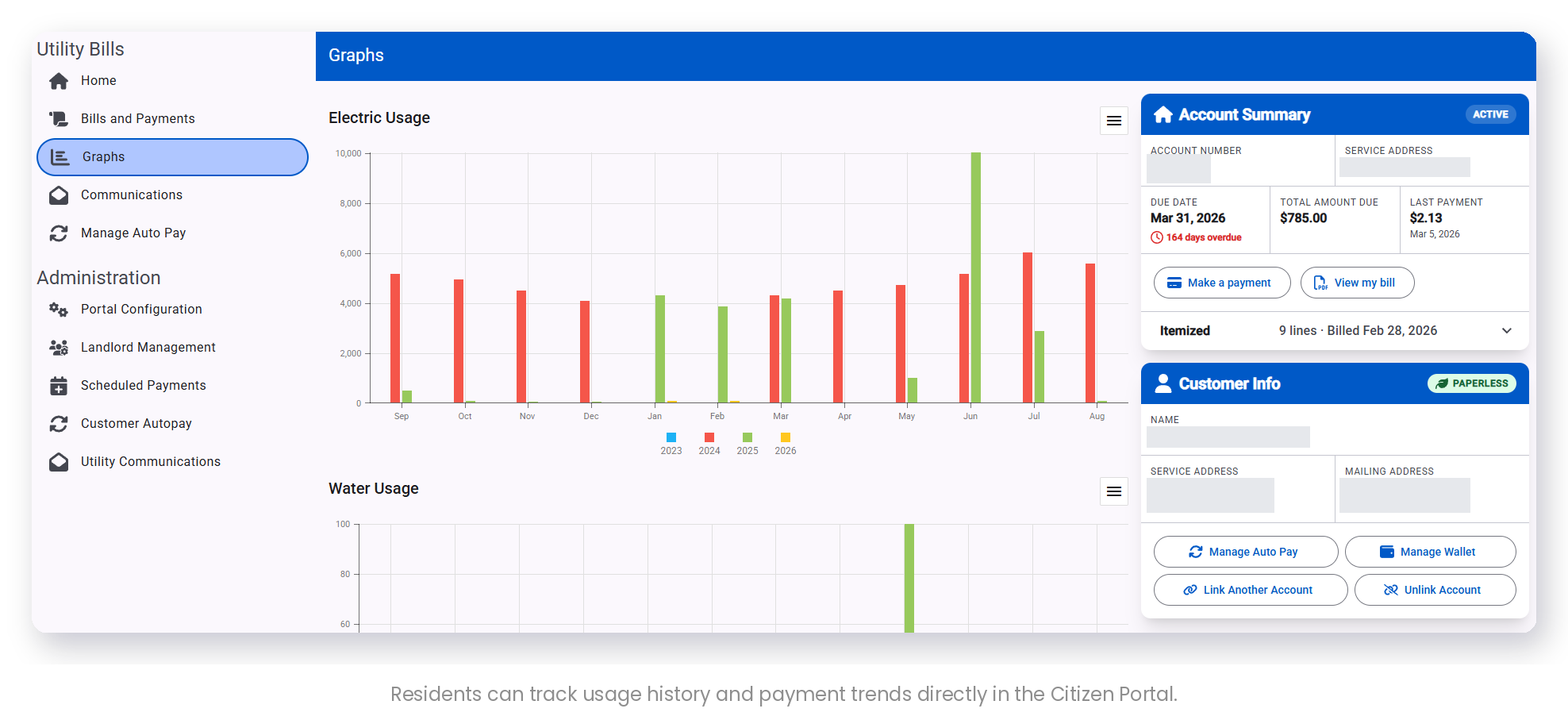
Every fix in this article lives in Caselle's Citizen Portal, real-time posting, built-in reconciliation, and an easier way for residents to pay.
Explore the Citizen Portal
